
Updated March 2026
Are you living with an autoimmune condition — rheumatoid arthritis, lupus, multiple sclerosis, or another immune-mediated disease — and struggling to find answers? What if the missing piece of your healing puzzle was hiding inside your own mouth?
At Blodgett Dental Care, we’ve seen it time and time again: patients who spent years cycling through specialists and treatments, only to discover that a root canal-treated tooth was quietly fueling systemic inflammation across their entire body. The science backs this up — and it’s time you knew about it.
What the Research Actually Says About Root Canals and Immune Disorders
One of the most common pushbacks we receive when sharing our clinical observations is: “There is no scientific evidence that root canals negatively impact systemic health.”
We respectfully disagree — and science does too.
We encourage skeptics and curious patients alike to visit PubMed and search PMID: 37373794. This will take you to a peer-reviewed article published in The Journal of Clinical Medicine (June 2023) titled:
“Root Canal Infection and its Impact on the Oral Cavity Microenvironment in the Context of Immune System Disorders in Selected Diseases: A Narrative Review”
This article brings the long-suppressed Focal Infection Theory back into modern scientific conversation — with rigorous, up-to-date evidence. The study’s own conclusion states its goal: “to present the current state of knowledge in the field of tooth root canal infections and its impact on the oral cavity microenvironment in the context of disorders of the immune system in selected diseases.”
In plain terms: infected root canals affect the immune system — and they affect it in measurable, documented ways.
A Brief History: Why the Focal Infection Theory Was Buried
The Focal Infection Theory — the idea that localized oral infections can trigger or worsen disease elsewhere in the body — was proposed over 100 years ago. It was widely accepted in the medical community until the 1940s and 1950s, when it was dismissed following a wave of biased editorial articles published in the Journal of the American Medical Association (see PMID: 33488729 for context).
These weren’t rigorous clinical trials. They were editorials. And yet they succeeded in suppressing this critical understanding for generations.
The result? Millions of patients have received root canals without being told about the immune-system implications — and millions more continue to suffer from mystery illnesses with no one connecting the dots.
We believe you deserve to know the full story.
How Root Canal Infections Drive Immune Dysfunction
The Mouth Is Not Separate From the Body
One of the foundational principles of biological dental care is that the mouth is not an isolated system. Every tooth sits within an intricate network of nerves, blood vessels, and lymphatic pathways. When infection takes root inside a tooth — as it inevitably does in root canal-treated teeth — it doesn’t stay contained.
Bacteria, bacterial toxins, and inflammatory byproducts enter the bloodstream and lymphatic system, triggering immune responses throughout the body.
Why All Root Canal-Treated Teeth Are Effectively Infected
The root canal procedure removes the visible nerve and pulp tissue from a tooth — but the tooth’s microscopic anatomy makes sterilization impossible. Tiny lateral canals and dentinal tubules (microscopic channels running through every tooth) cannot be fully cleaned or sealed.
What remains is a dead, anaerobic environment — exactly the conditions in which the most dangerous, toxin-producing bacteria thrive.
This is not a fringe opinion. To understand this further, read our deep-dive on why all root canal-treated teeth become toxic teeth, and learn about the connection between autoimmune disease and root canals directly from our clinical perspective.
The Energy Meridian Connection
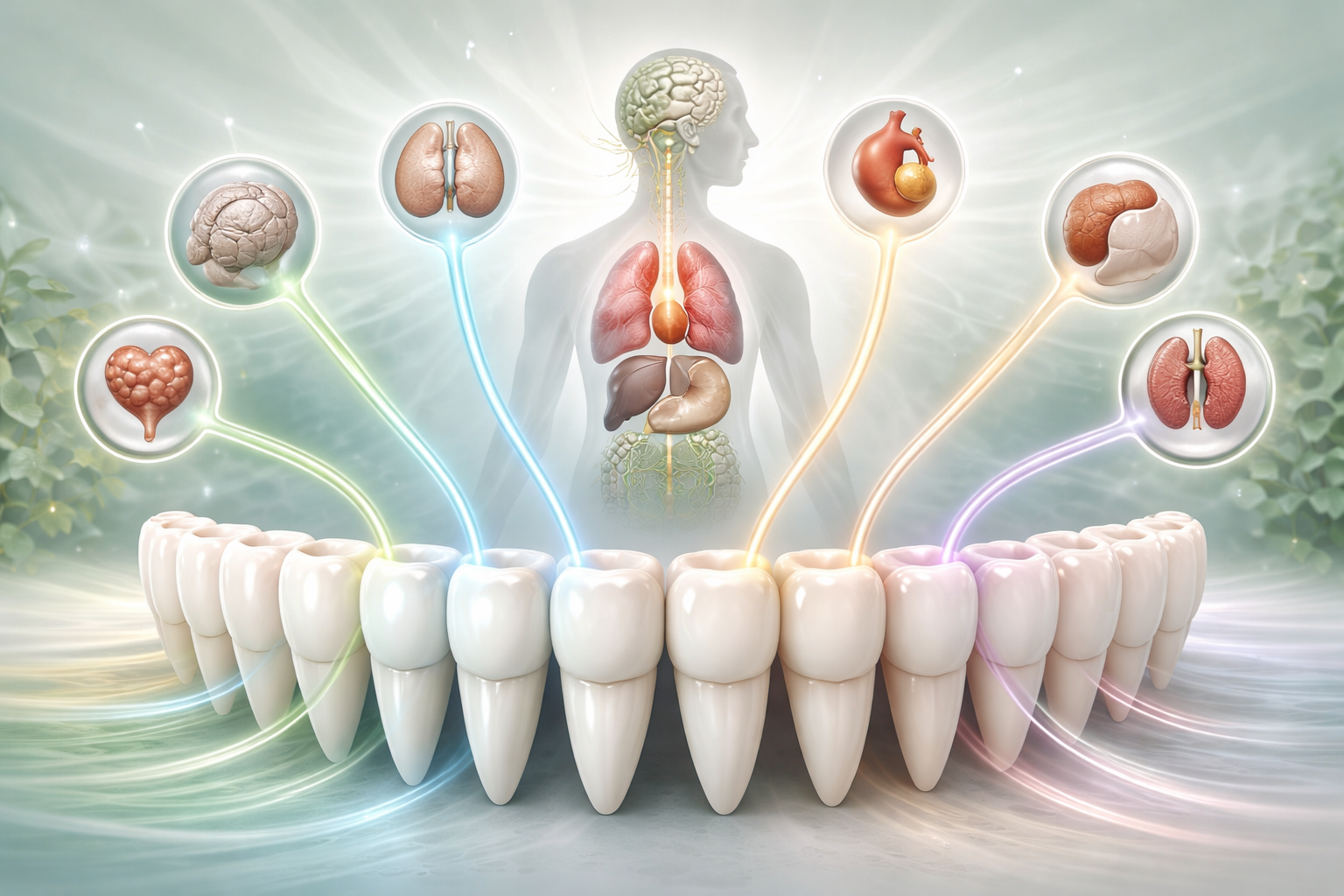
In biological and holistic dentistry, we also consider the body’s energy meridians — pathways that connect each tooth to specific organs and organ systems. An infected tooth isn’t just creating localized inflammation. It may be disrupting the energetic and physiological function of the organs it connects to.
This is why patients sometimes experience dramatic whole-body improvements after the safe removal of a toxic tooth — improvements that go far beyond what conventional dentistry would predict.
Autoimmune Conditions Linked to Chronic Oral Infection
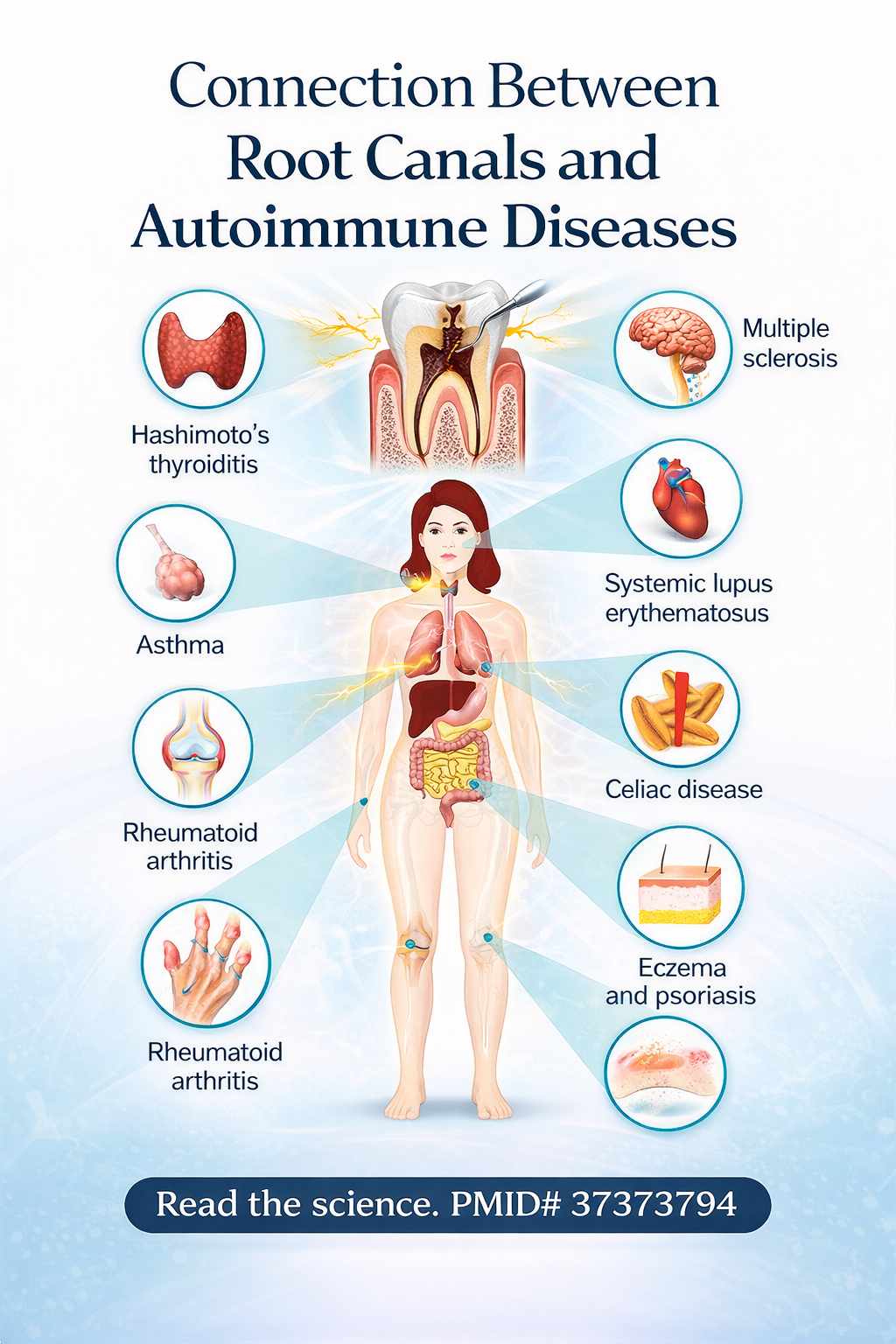
The 2023 Journal of Clinical Medicine review highlights several immune-mediated conditions that have documented connections to root canal infections and chronic oral pathology. These include:
- Rheumatoid Arthritis — One of the most well-researched oral-systemic connections. Learn more in our post on rheumatoid arthritis and root canals.
- Cardiovascular disease — Oral bacteria have been found in arterial plaques.
- Diabetes — Bidirectional relationship between gum disease, oral infection, and blood sugar dysregulation. See our post on dental care and diabetes.
- Breast cancer — Emerging research on oral infection and breast cancer is reshaping how we think about preventive care.
- Sinus and respiratory issues — Infected upper teeth sit millimeters from the sinus cavity. See our post on sinus pain and root canals.
- Skin conditions — Even dermatitis can be caused by issues in your mouth.
This is the oral-systemic connection — and it has profound implications for how you approach your health.
What Are Your Alternatives to a Root Canal?
If you’ve been told you need a root canal, know this: you have options.
At Blodgett Dental Care, we specialize in root canal alternatives that honor the whole body, not just the tooth. Depending on your clinical situation, alternatives may include:
- Tooth extraction with a biological protocol — including proper cavitation surgery to prevent jawbone infections
- Dental implants using biocompatible materials — learn about our approach to dental implants
- Ozone therapy to treat decay before it reaches the nerve — see our ozone therapy services
- Minimally invasive fillings — learn more here
If you already have root canal-treated teeth, our safe root canal removal protocol is designed to address the infection, protect you from re-exposure to bacterial toxins, and support your body’s natural healing process.
Already Have Root Canals? Here’s What You Need to Know
Having root canals doesn’t automatically mean you’re in crisis — but it does mean you deserve a thorough evaluation. At BDC, we use 3D oral scanning and advanced diagnostics to assess the true state of your jawbone, teeth, and surrounding tissue — going far beyond what a traditional 2D X-ray can reveal.
We also evaluate for jawbone cavitations — areas of dead or dying bone that often develop in extraction sites or around infected teeth, and that can silently perpetuate systemic immune dysfunction.
Our root canal removal protocol is one of the most comprehensive in the Pacific Northwest, built to protect your immune system before, during, and after treatment.
The Mercury Problem: Another Hidden Immune Trigger
If you have silver (amalgam) fillings, you have mercury in your mouth. Mercury is one of the most potent neurotoxins known to science, and its connection to immune dysregulation and neurological conditions is well-documented.
Learn about mercury exposure and the risks of putting mercury in your mouth. When you’re ready, our SMART mercury removal protocol ensures the safest possible removal process — protecting you, our team, and the environment.
If You’re Suffering and Haven’t Found Answers — Read This
If you are living with an immune-mediated disease and have not found a lasting cure through conventional medicine, we urge you to consider the possibility that your oral health is part of the equation.
- Share the 2023 Journal of Clinical Medicine article (PMID: 37373794) with your medical and dental team.
- Ask about the oral-systemic connection.
- Explore whether root canal-treated teeth, chronic oral infection, or heavy metal exposure could be contributing to your condition.
You can also read our article on what happens when chronic infections are removed and the body heals itself — a powerful read for anyone who has struggled with unexplained illness.
This is not fringe medicine. This is science that has been suppressed — and it’s time to bring it into the light.
Why Patients Travel to Portland for Biological Dental Care
Patients come to Blodgett Dental Care from across the country — and around the world — because they can’t find this level of care at home. If you’re considering making the trip, explore our complete dental tourism section, including:
We have helped countless patients regain their health by addressing what conventional dentistry overlooked. You could be next.
Blodgett Dental Care — Human Beings Helping Human Beings
At BDC, we don’t believe in dental dogma. We believe in your goals coming first, in whole-health support, and in presenting every option so you get to choose based on your values.
If you’re ready to explore whether your oral health is connected to your systemic health, we would love to hear from you.
📧 Email us at: info@bdcpdx.com
🌐 Request an Appointment
✈️ Explore our Dental Tourism solutions
Blodgett Dental Care — Serving Portland, Oregon and patients worldwide who are ready to think differently about their health.
Autoimmune and Systemic Conditions Linked to Chronic Oral Infection
Chronic oral infection, root canal infection, and long-term oral inflammation are increasingly part of the conversation around whole-body health. These are several of the conditions most often discussed in connection with hidden dental infection.
Autoimmune and inflammatory conditions
- Rheumatoid arthritis — One of the best-known oral-systemic links involving chronic inflammation and hidden infection. Read more about rheumatoid arthritis and root canals.
- Breast cancer — Research continues to shape how many practitioners think about prevention, inflammation, and chronic oral infection. Learn more about oral infection and breast cancer.
Metabolic and cardiovascular health
- Cardiovascular disease — Oral bacteria have been found in arterial plaque, reinforcing the connection between dental infection and systemic inflammation.
- Diabetes — Blood sugar dysregulation and oral inflammation can worsen one another, making dental health an important part of whole-body care. See our post on dental care and diabetes.
Sinus and respiratory symptoms
- Sinus and respiratory issues — Infected upper teeth can sit only millimeters from the sinus cavity, which is why upper tooth infection and root canal infection sometimes contribute to sinus pain and ongoing symptoms. Learn more about sinus pain and root canals.
FAQs About Autoimmune Disease, Root Canals, and Chronic Oral Infection
If you are living with autoimmune symptoms, chronic inflammation, or a root canal-treated tooth, these are some of the most important questions to ask about the oral-systemic connection.
Can root canals affect autoimmune disease?
Many patients and biological dentists believe they can. The concern is that a root canal infection may continue to expose the body to bacteria, bacterial toxins, and inflammatory byproducts, which can add to an already overburdened immune system.
What is the connection between autoimmune disease and root canals?
The connection is centered on chronic oral infection and systemic inflammation. A root canal-treated tooth may no longer be vital, yet still contain inaccessible spaces where harmful anaerobic bacteria can persist and influence the body beyond the mouth.
Can a hidden tooth infection trigger chronic inflammation?
It may. Hidden dental infection, jawbone cavitations, and infected root canal-treated teeth are all concerns in biological dentistry because they may contribute to long-term inflammatory stress that the body has to keep responding to.
Are root canal-treated teeth considered infected?
From a biological dentistry perspective, that is often the concern. Because the microscopic anatomy of a tooth cannot be fully sterilized, many practitioners believe root canal-treated teeth are prone to remaining chronically contaminated even after treatment.
Which autoimmune conditions are most often discussed with root canal infections?
Commonly discussed conditions include rheumatoid arthritis, lupus, Hashimoto’s thyroiditis, multiple sclerosis, celiac disease, eczema, psoriasis, and asthma, along with broader immune-mediated and inflammatory patterns.
Can root canals contribute to rheumatoid arthritis symptoms?
Rheumatoid arthritis is one of the best-known oral-systemic links discussed in this space. While every case is different, patients with autoimmune symptoms often seek a second opinion when they suspect a root canal and rheumatoid arthritis connection.
What are signs that a root canal-treated tooth may be causing problems?
Sometimes there are obvious symptoms like pain, swelling, tenderness, sinus pressure, bad taste, or gum irritation. In other cases, the problem may be quieter, showing up as chronic inflammation, recurring health issues, or findings on 3D dental imaging.
How do biological dentists evaluate root canal concerns?
A biological dentist typically looks beyond a basic 2D X-ray. Evaluation may include a detailed health history, advanced diagnostics, 3D oral scanning, review of symptoms, and assessment for jawbone cavitations, hidden infection, and inflammatory burden.
What are the alternatives to keeping a root canal-treated tooth?
Depending on the clinical situation, options may include safe root canal removal, tooth extraction with a biological protocol, cavitation treatment, and replacement planning such as biocompatible dental implants. The right path depends on your goals, symptoms, and overall health picture.
Should you get a second opinion if you have autoimmune disease and a root canal?
For many patients, yes. If you have an autoimmune condition, unexplained chronic inflammation, or ongoing symptoms that have not improved, a second opinion from a biological dentist may help you determine whether oral infection is part of the bigger picture.
The mouth may be part of the answer.
If you have been searching for the source of chronic inflammation, hidden dental infection and root canal-treated teeth may be worth investigating as part of a whole-body health approach.
Read Also

Ceramic Veneers: The Psychology and Whole-Health Benefits of a Beautiful Smile
Table of Contents Toggle Smile Spotlight | Blodgett Dental Care What Are Ceramic Veneers? Why People Choose Veneers Oral Health Meets Whole-Body Wellness Are Veneers Right…

Oral Infection and Breast Cancer: Why Oral Health Matters More Than You Think
Table of Contents Toggle Toxic Tuesday | Blodgett Dental Care How Oral Infection Can Affect Breast Health A Biological Dentistry Perspective Prevention Starts With Oral…